Quantum error correction and fault-tolerant quantum computation
In fault-tolerant quantum computing with the surface code, non-Clifford gates are essential for achieving universal computation. However, existing approaches, such as magic state distillation and code switching, are resource-intensive. My collaborators and I have proposed a protocol that combines magic state preparation with code switching to implement logical non-Clifford operations.
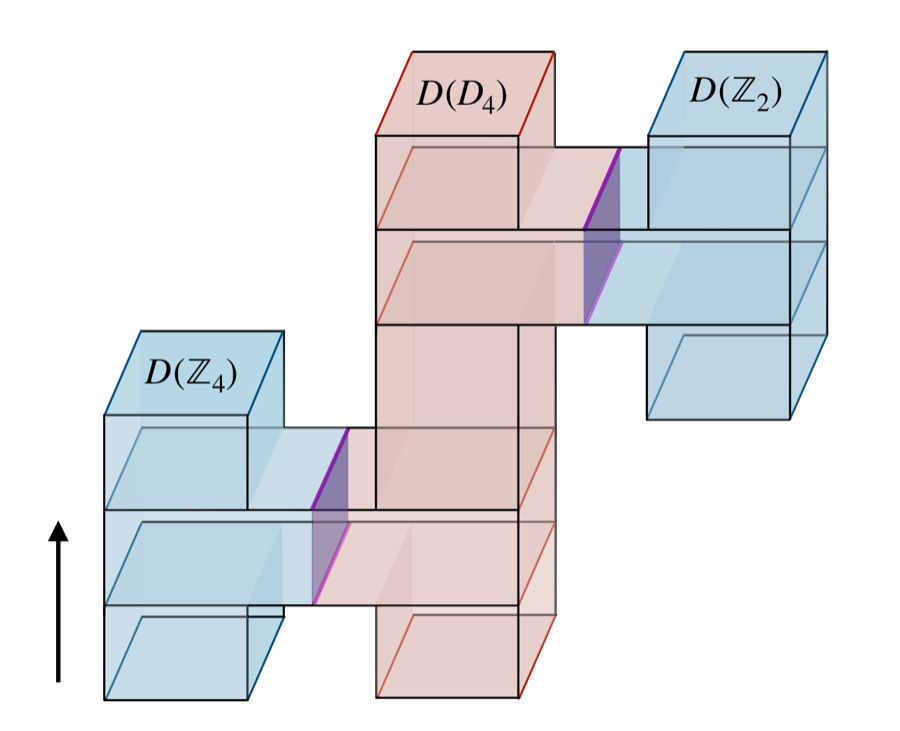
Our approach starts with a specially prepared logical state in the \(\mathbb{Z}_4\) surface code. Through a sequence of transformations involving gauging and anyon condensation, the system transitions through various topological codes, notably including the non-Abelian \(D_4\) quantum double model. This process ultimately produces a magic state in a condensed \(\mathbb{Z}_2\) surface code, which enables the implementation of a logical T gate in the standard \(\mathbb{Z}_2\) surface code through gate teleportation.
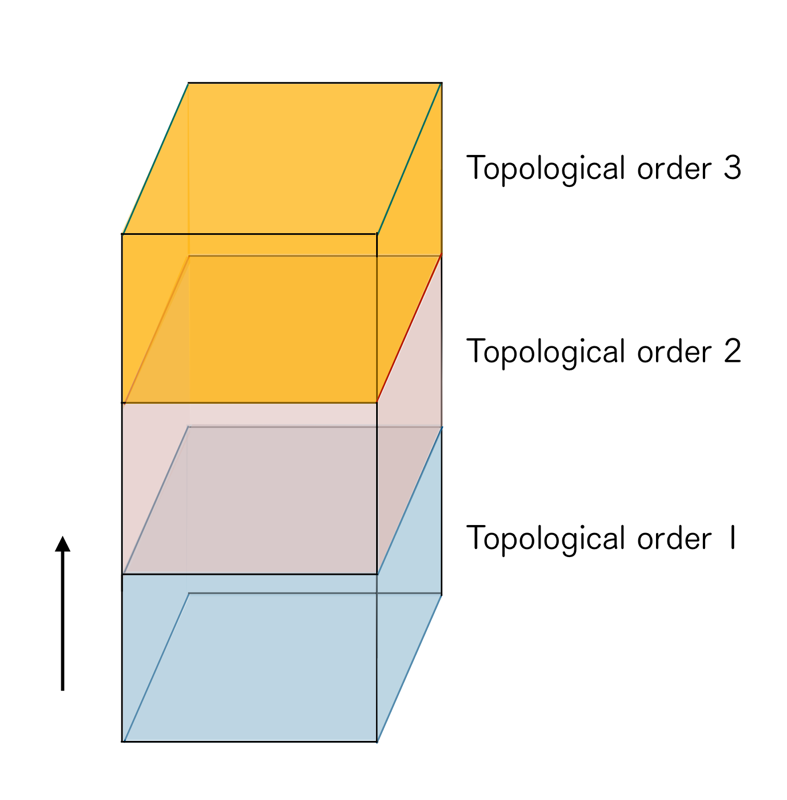
We have also generalized standard lattice surgery to hybrid lattice surgery, in which rough merge and rough split operations happen across different topological codes. Applying these procedures between Abelian and non-Abelian codes provides non-Clifford operations in the standard surface code, in the form of a magic state or a non-Clifford gate teleportation. We also give a continuum topological field theory description of hybrid lattice surgery using interfaces between (2+1)d topological orders.
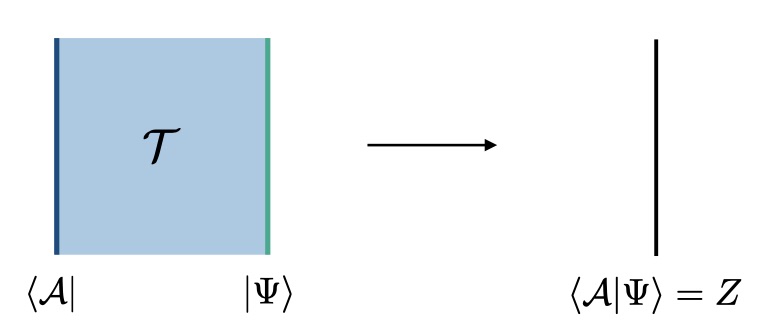
We develop smooth hybrid lattice surgery for group surface codes, enabling joint logical measurements through merge and split operations along smooth boundaries. The code patches may correspond to identical or different finite groups, including non-Abelian groups. Our central result is that smooth merge and split realize a logical K-coset measurement, where K is the subgroup defining the interface. This generalizes the joint logical parity measurement of ordinary surface codes. Using a tensor-network representation, we derive explicit measurement circuits and develop procedures for correcting nonidentity measurement outcomes. We illustrate the framework through a generalized controlled multiplication gate between group surface codes and protocols for preparing the T, CZ, CCX, and CS magic states, producing resources encoded in one or more \mathbbZ_2 surface code patches. Our results show how smooth hybrid lattice surgery broadens the range of logical operations available for group surface codes.
@article{ding2026hybrid,title={Hybrid Lattice Surgery between Smooth Boundaries},author={Ding, Grace and Chen, Yanzhu and Huang, Sheng-Jie},journal={arXiv:2610.27556},year={2026},}
Hybrid Lattice Surgery: Non-Clifford Gates via Non-Abelian Surface Codes
Sheng-Jie Huang, Alison Warman, Sakura Schafer-Nameki, and Yanzhu Chen
In universal fault-tolerant quantum computing, implementing logical non-Clifford gates often demands substantial spacetime resources for many error-correcting codes, including the high-threshold surface code. A critical mission for realizing large-scale quantum computing is to develop simple and resource-efficient implementations of logical non-Clifford gates. We propose a novel way of implementing non-Clifford operations in the standard surface code based on hybrid lattice surgery. First we generalize the standard lattice surgery to hybrid lattice surgery, where operations of rough merge and rough split happen across different topological codes. Then we apply such procedures between Abelian and non-Abelian codes and show that this can provide non-Clifford operations in the standard surface code, in the form of a magic state or a non-Clifford gate teleportation. Complementing this, we provide a continuum topological field theory description of this hybrid lattice surgery utilizing interfaces between (2+1)d topological orders. From these considerations, we can generalize our protocol to non-Clifford gates and magic states at all finite levels of the Clifford hierarchy, as well as gates beyond the hierarchy. We also discuss protocols extending this framework to qutrits.
@article{huang2025hybrid,title={Hybrid Lattice Surgery: Non-Clifford Gates via Non-Abelian Surface Codes},author={Huang, Sheng-Jie and Warman, Alison and Schafer-Nameki, Sakura and Chen, Yanzhu},journal={arXiv:2510.20890},year={2025},}
Generating logical magic states with the aid of non-Abelian topological order
In fault-tolerant quantum computing with the surface code, non-Clifford gates are crucial for universal computation. However, implementing these gates using methods like magic state distillation and code switching requires significant resources. In this work, we propose a new protocol that combines magic state preparation and code transformation to realize logical non-Clifford operations with the potential for fault tolerance. Our approach begins with a special logical state in the \mathbbZ_4 surface code. By applying a sequence of transformations, the system goes through different topological codes, including the non-Abelian D_4 quantum double model. This process ultimately produces a magic state encoded in the \mathbbZ_2 surface code. A logical T gate can be implemented in the standard \mathbbZ_2 surface code by gate teleportation. In our analysis, we employ a framework where the topological codes are represented by their topological orders and all the transformations are considered as topological manipulations such as gauging symmetries and condensing anyons. This perspective is particularly useful for understanding transformations between topological codes.
@article{huang2025generating,title={Generating logical magic states with the aid of non-Abelian topological order},author={Huang, Sheng-Jie and Chen, Yanzhu},journal={arXiv:2502.00998},year={2025},}
Topological holography
The essential idea of topological holography is to encode a generalized symmetry and its symmetry charges into a topological order in one higher dimension. This topological order goes by several names, such as symmetry topological field theory (SymTFT) or symmetry topological order (SymTO).
Together with Meng Cheng, I have applied the topological holography picture to a variety of exotic quantum critical points and gapless phases in (1+1)d. These include:
phase transitions between SPT phases;
symmetry-enriched quantum critical points (transitions between an SPT and a symmetry-breaking phase);
deconfined quantum critical points;
intrinsically gapless SPT phases.
Many of these exotic quantum critical points and gapless phases can be characterized by non-trivial responses in the symmetry defect operators and twisted partition functions. We also developed a topological holographic picture for conformal boundary states of (1+1)d RCFTs, which uncovers the nature of the gapped phases that correspond to those boundary states.
I have further generalized the topological holography picture to fermionic systems and studied exotic fermionic quantum critical points from this viewpoint. More recently, my collaborators and I have extended this picture to (2+1)d gapped and gapless phases with non-invertible symmetries, and developed a general construction of lattice models for (2+1)d gapped phases with non-invertible symmetries.
What I like about this picture is that it lets us use the intuition and techniques of topological order to derive general statements about critical points and gapless phases.
Related publications
(2+1)d Lattice Models and Tensor Networks for Gapped Phases with Categorical Symmetry
Kansei Inamura, Sheng-Jie Huang, Apoorv Tiwari, and Sakura Schafer-Nameki
Gapped phases in 2+1 dimensional quantum field theories with fusion 2-categorical symmetries were recently classified and characterized using the Symmetry Topological Field Theory (SymTFT) approach arXiv:2408.05266, arXiv:2502.20440. In this paper, we provide a systematic lattice model construction for all such gapped phases. Specifically, we consider "all-boson type" fusion 2-category symmetries, all of which are obtainable from 0-form symmetry groups G (possibly with an ’t Hooft anomaly) via generalized gauging–that is, by stacking with an H-symmetric TFT and gauging a subgroup H. The continuum classification directly informs the lattice data, such as the generalized gauging that determines the symmetry category, and the data that specifies the gapped phase. We construct commuting projector Hamiltonians and ground states applicable to any non-chiral gapped phase with such symmetries. We also describe the ground states in terms of tensor networks. In light of the length of the paper, we include a self-contained summary section presenting the main results and examples.
@article{inamura202521d,title={(2+1)d Lattice Models and Tensor Networks for Gapped Phases with Categorical Symmetry},author={Inamura, Kansei and Huang, Sheng-Jie and Tiwari, Apoorv and Schafer-Nameki, Sakura},journal={SciPost Phys.},volume={20},pages={043},year={2026},doi={10.21468/SciPostPhys.20.2.043},}
Gapless Phases in (2+1)d with Non-Invertible Symmetries
The study of gapless phases with categorical (or so-called non-invertible) symmetries is a formidable task, in particular in higher than two space-time dimensions. In this paper we build on previous works arXiv:2408.05266 and arXiv:2502.20440 on gapped phases in (2+1)d and provide a systematic framework to study phase transitions with categorical symmetries. The Symmetry Topological Field Theory (SymTFT) is, as often in these matters, the central tool. Applied to gapless theories, we need to consider the extension of the SymTFT to interfaces between topological orders, so-called “club sandwiches", which realize generalizations of so-called Kennedy-Tasaki (KT) transformations. This requires an input phase transition for a smaller symmetry, such as the Ising transition for \mathbbZ_2, and the SymTFT constructs a transformation to a gapless phase with a larger categorical symmetry. We carry this out for categorical symmetries whose SymTFT is a (3+1)d Dijkgraaf-Witten (DW) theory for a finite group G with twist – so-called all bosonic fusion 2-categories. We classify such interfaces using a physically motivated picture of generalized gauging, as well as with a complementary analysis using (bi-)module 2-categories.This is exemplified in numerous abelian and non-abelian DW theories, giving rise to interesting gapless phases such as intrinsically gapless symmetry protected phases (igSPTs) and spontaneous symmetry breaking phases (igSSBs) from abelian, S_3, and D_8 DW theories.
@article{bhardwaj2025gapless,title={Gapless Phases in (2+1)d with Non-Invertible Symmetries},author={Bhardwaj, Lakshya and Gai, Yuhan and Huang, Sheng-Jie and Inamura, Kansei and Schafer-Nameki, Sakura and Tiwari, Apoorv and Warman, Alison},journal={SciPost Phys.},volume={21},pages={019},year={2026},doi={10.21468/SciPostPhys.21.1.019},}
Fermionic quantum criticality through the lens of topological holography
We utilize the topological holographic framework to characterize and gain insights into the nature of quantum critical points and gapless phases in fermionic quantum systems. Topological holography is a general framework that describes the generalized global symmetry and the symmetry charges of a local quantum system in terms of a slab of a topological order, termed as the symmetry topological field theory (SymTFT), in one higher dimension. In this work, we consider a generalization of the topological holographic picture for (1+1)d fermionic quantum phases of matter. We discuss how spin structures are encoded in the SymTFT and establish the connection between the formal fermionization formula in quantum field theory and the choice of fermionic gapped boundary conditions of the SymTFT. We demonstrate the identification and the characterization of the fermionic gapped phases and phase transitions through detailed analysis of various examples, including the fermionic systems with \mathbbZ_2^F, \mathbbZ_2 \times \mathbbZ_2^F, \mathbbZ_4^F, and the fermionic version of the non-invertible \textRep(S_3) symmetry. Our work uncovers many exotic fermionic quantum critical points and gapless phases, including two kinds of fermionic symmetry enriched quantum critical points, a fermionic gapless symmetry protected topological (SPT) phase, and a fermionic gapless spontaneous symmetry breaking (SSB) phase that breaks the fermionic non-invertible symmetry.
@article{huang2024fermionic,title={Fermionic quantum criticality through the lens of topological holography},author={Huang, Sheng-Jie},journal={Phys. Rev. B},volume={111},pages={155130},year={2025},doi={10.1103/PhysRevB.111.155130},}
Topological holography, quantum criticality, and boundary states
Topological holography is a holographic principle that describes the generalized global symmetry of a local quantum system in terms of a topological order in one higher dimension. This framework separates the topological data from the local dynamics of a theory and provides a unified description of the symmetry and duality in gapped and gapless phases of matter. In this work, we develop the topological holographic picture for (1+1)d quantum phases, including both gapped phases as well as a wide range of quantum critical points, including phase transitions between symmetry protected topological (SPT) phases, symmetry enriched quantum critical points, deconfined quantum critical points, and intrinsically gapless SPT phases. Topological holography puts a strong constraint on the emergent symmetry and the anomaly for these critical theories. We show how the partition functions of these critical points can be obtained from dualizing (orbifolding) more familiar critical theories. The topological responses of the defect operators are also discussed in this framework. We further develop a topological holographic picture for conformal boundary states of (1+1)d rational conformal field theories. This framework provides a simple physical picture to understand conformal boundary states and also uncovers the nature of the gapped phases corresponding to the boundary states.
@article{huang2023topological,title={Topological holography, quantum criticality, and boundary states},author={Huang, Sheng-Jie and Cheng, Meng},journal={SciPost Phys.},volume={18},pages={213},year={2025},doi={10.21468/SciPostPhys.18.6.213},}
Generalized symmetries in topological quantum matter and quantum error-correcting codes
Symmetry has played a crucial role in classifying quantum matter. The notion of global symmetry has recently been generalized in both the condensed matter and high-energy communities to include higher-form, higher-group, and non-invertible symmetries. An emerging picture is that generalized symmetry is equivalent to topological defects, summarized by the slogan “Symmetry = Topological defect”.
My colleagues and I have investigated different aspects of topological defects in (3+1)d topological orders. We give several general constructions of codimension-2 defects through (1) gauging lower-dimensional invertible (SPT) phases, (2) layer constructions, and (3) anyon condensation. We also uncover part of the 3-group structure that captures the interplay between codimension-2 defects and defects of lower codimension.
The mathematical description of this 3-group structure translates into transversal logical gates in the corresponding topological error-correcting codes: it corresponds to non-trivial commutation relations between logical gates that fit into the Clifford hierarchy. This connection reveals the essential role of higher-group structure in the existence of transversal non-Clifford gates.
Related publication
Codimension-2 defects and higher symmetries in (3+1)D topological phases
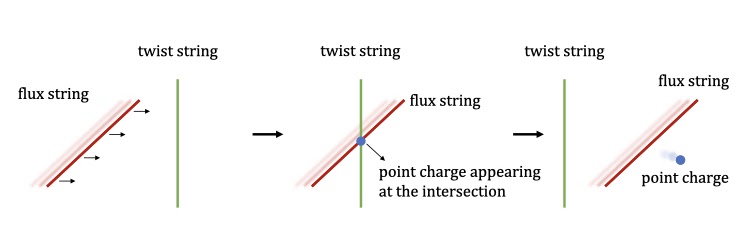
(3+1)D topological phases of matter can host a broad class of non-trivial topological defects of codimension-1, 2, and 3, of which the well-known point charges and flux loops are special cases. The complete algebraic structure of these defects defines a higher category, and can be viewed as an emergent higher symmetry. This plays a crucial role both in the classification of phases of matter and the possible fault-tolerant logical operations in topological quantum error correcting codes. In this paper, we study several examples of such higher codimension defects from distinct perspectives. We mainly study a class of invertible codimension-2 topological defects, which we refer to as twist strings. We provide a number of general constructions for twist strings, in terms of gauging lower dimensional invertible phases, layer constructions, and condensation defects. We study some special examples in the context of \mathbbZ_2 gauge theory with fermionic charges, in \mathbbZ_2 \times \mathbbZ_2 gauge theory with bosonic charges, and also in non-Abelian discrete gauge theories based on dihedral (D_n) and alternating (A_6) groups. The intersection between twist strings and Abelian flux loops sources Abelian point charges, which defines an H^4 cohomology class that characterizes part of an underlying 3-group symmetry of the topological order. The equations involving background gauge fields for the 3-group symmetry have been explicitly written down for various cases. We also study examples of twist strings interacting with non-Abelian flux loops (defining part of a non-invertible higher symmetry), examples of non-invertible codimension-2 defects, and examples of interplay of codimension-2 defects with codimension-1 defects. We also find an example of geometric, not fully topological, twist strings in (3+1)D A_6 gauge theory.
@article{barkeshli2022codimension2,title={Codimension-2 defects and higher symmetries in (3+1)D topological phases},author={Barkeshli, Maissam and Chen, Yu-An and Huang, Sheng-Jie and Kobayashi, Ryohei and Tantivasadakarn, Nathanan and Zhu, Guanyu},journal={SciPost Phys.},volume={14},pages={065},year={2023},doi={10.21468/SciPostPhys.14.4.065},}
Crystalline and quasicrystalline topological phases
Crystalline symmetry can protect non-trivial topological phases and leads to interesting higher-order boundary phenomena such as hinge or corner modes. I have developed a general theoretical framework, the topological crystal approach, to systematically classify and characterize these phases. The essential idea is that any topological crystalline phase has a corresponding real-space crystalline stacking pattern of lower-dimensional topological states, which we systematically classified.
I have applied this approach to classify bosonic crystalline SPT phases and fermionic topological crystalline insulators (TCIs). Based on this picture, I have also studied surface field theories for bosonic SPT phases with point group symmetry, as well as exotic crystalline SPT phases and their surface theories in 4d space. More recently, I have generalized the topological crystal approach to classify interacting Dirac semimetals. The framework has a clear physical picture, applies to both bosonic and fermionic systems, readily incorporates strong interactions, and gives access to boundary signatures and topological responses.
Given this progress in classifying crystalline topological phases, a natural question is whether topological phenomena can be protected by the structure of quasicrystals. Building on the topological crystal framework, my collaborators and I have studied quasicrystalline topological phases and their topological responses. We also found intrinsically quasicrystalline phases, which have no crystalline analogs.
Topological band theory predicts a \mathbbZ classification of three-dimensional (3D) Dirac semimetals (DSMs) at the single-particle level. Namely, an arbitrary number of identical bulk Dirac nodes will always remain locally stable and gapless in the single-particle band spectrum, as long as the protecting symmetry is preserved. In this work, we find that this single-particle classification for C_n-symmetric DSMs will break down to \mathbbZ_n/\textgcd(2,n) in the presence of symmetry-preserving electron interactions. Our theory is based on a dimensional reduction strategy which reduces a 3D Dirac fermions to 1D building blocks, i.e., vortex-line modes, while respecting all the key symmetries. Using bosonization technique, we find that there exists a minimal number N=n/\textgcd(2,n) such that the collection of vortex-line modes in N copies of DSMs can be symmetrically eliminated via four-fermion interactions. While this gapping mechanism does not have any free-fermion counterpart, it yields an intuitive “electron-trion coupling" picture. By developing a topological field theory for DSMs and further checking the anomaly-free condition, we independently arrive at the same classification results. Our theory paves the way for understanding topological crystalline semimetallic phases in the strongly correlated regime.
@article{huang2022classification,title={Classification of Interacting Dirac Semimetals},author={Huang, Sheng-Jie and Yu, Jiabin and Zhang, Rui-Xing},journal={Phys. Rev. B},volume={110},pages={035134},year={2024},doi={10.1103/PhysRevB.110.035134},}
Effective field theories of topological crystalline insulators and topological crystals
We present a general approach to obtain effective field theories for topological crystalline insulators whose low-energy theories are described by massive Dirac fermions. We show that these phases are characterized by the responses to spatially dependent mass parameters with interfaces. These mass interfaces implement the dimensional reduction procedure such that the state of interest is smoothly deformed into a topological crystal, which serves as a representative state of a phase in the general classification. Effective field theories are obtained by integrating out the massive Dirac fermions, and various quantized topological terms are uncovered. Our approach can be generalized to other crystalline symmetry protected topological phases and provides a general strategy to derive effective field theories for such crystalline topological phases.
@article{huang2021effective,title={Effective field theories of topological crystalline insulators and topological crystals},author={Huang, Sheng-Jie and Hsieh, Chang-Tse and Yu, Jiabin},journal={Phys. Rev. B},volume={105},pages={045112},year={2022},doi={10.1103/PhysRevB.105.045112},}
Quantum many-body topology of quasicrystals
Dominic V. Else, Sheng-Jie Huang, Abhinav Prem, and Andrey Gromov
In this paper, we characterize quasicrystalline interacting topological phases of matter i.e., phases protected by some quasicrystalline structure. We show that the elasticity theory of quasicrystals, which accounts for both "phonon" and "phason" modes, admits non-trivial quantized topological terms with far richer structure than their crystalline counterparts. We show that these terms correspond to distinct phases of matter and also uncover intrinsically quasicrystalline phases, which have no crystalline analogues. For quasicrystals with internal \mathrmU(1) symmetry, we discuss a number of interpretations and physical implications of the topological terms, including constraints on the mobility of dislocations in d=2 quasicrystals and a quasicrystalline generalization of the Lieb-Schultz-Mattis-Oshikawa-Hastings theorem. We then extend these ideas much further and address the complete classification of quasicrystalline topological phases, including systems with point-group symmetry as well as non-invertible phases. We hence obtain the "Quasicrystalline Equivalence Principle," which generalizes the classification of crystalline topological phases to the quasicrystalline setting.
@article{else2021quantum,title={Quantum many-body topology of quasicrystals},author={Else, Dominic V. and Huang, Sheng-Jie and Prem, Abhinav and Gromov, Andrey},journal={Phys. Rev. X},volume={11},pages={041051},year={2021},doi={10.1103/PhysRevX.11.041051},}
4D beyond-cohomology topological phase protected by C_2 symmetry and its boundary theories
We study bosonic symmetry protected topological (SPT) phases with C_2 rotational symmetry in four spatial dimensions which is not captured by the group cohomology classification. By using the topological crystal approach, we show that the topological crystalline state of this SPT phase is given by placing an E_8 state on the two dimensional rotational invariant plane, which provides a simple physical picture of this phase. Based on this understanding, we show that a variant of QED4 with charge-1 and charge-3 Dirac fermions is a field theoretical description of the three dimensional boundary. We also discuss the connection to symmetric gapped boundary with topological order and its anomaly signature.
@article{huang20204d,title={4D beyond-cohomology topological phase protected by $C_2$ symmetry and its boundary theories},author={Huang, Sheng-Jie},journal={Phys. Rev. Research},volume={2},pages={033236},year={2020},doi={10.1103/PhysRevResearch.2.033236},}
Bosonic Crystalline Symmetry Protected Topological Phases Beyond the Group Cohomology Proposal
Hao Song, Charles Zhaoxi Xiong, and Sheng-Jie Huang
It is demonstrated by explicit construction that three-dimensional bosonic crystalline symmetry protected topological (cSPT) phases are classified by H_φ^5(G;\mathbbZ)⊕H_φ^1(G;\mathbbZ) for all 230 space groups G, where H^n_φ(G;\mathbbZ) denotes the nth twisted group cohomology of G with \mathbbZ coefficients, and φ indicates that g∈G acts non-trivially on coefficients by sending them to their inverses if g reverses spacetime orientation and acts trivially otherwise. The previously known summand H_φ^5(G;\mathbbZ) corresponds only to crystalline phases built without the E_8 state or its multiples on 2-cells of space. It is the crystalline analogue of the "group cohomology proposal" for classifying bosonic symmetry protected topological (SPT) phases, which takes the form H_φ^d+2(G;\mathbbZ)≅H_φ^d+1(G;U(1)) for finite internal symmetry groups in d spatial dimensions. The new summand H_φ^1(G;\mathbbZ) classifies possible configurations of E_8 states on 2-cells that can be used to build crystalline phases beyond the group cohomology proposal. The completeness of our classification and the physical meaning of H_φ^1(G;\mathbbZ) are established through a combination of dimensional reduction, surface topological order, and explicit cellular construction. The value of H_φ^1(G;\mathbbZ) can be easily read off from the international symbol for G. Our classification agrees with the prediction of the "generalized cohomology hypothesis," which concerns the general structure of the classification of SPT phases, and therefore provides strong evidence for the validity of the said hypothesis in the realm of crystalline symmetries.
@article{song2018bosonic,title={Bosonic Crystalline Symmetry Protected Topological Phases Beyond the Group Cohomology Proposal},author={Song, Hao and Xiong, Charles Zhaoxi and Huang, Sheng-Jie},journal={Phys. Rev. B},volume={101},pages={165129},year={2020},doi={10.1103/PhysRevB.101.165129},}
Topological states from topological crystals
Zhida Song, Sheng-Jie Huang, Yang Qi, Chen Fang, and Michael Hermele
We present a scheme to explicitly construct and classify general topological states jointly protected by an onsite symmetry group and a spatial symmetry group. We show that all these symmetry protected topological states can be adiabatically deformed (allowing for stacking of trivial states) into a special class of states we call topological crystals. A topological crystal in, for example, three dimensions is a real-space assembly of finite-sized pieces of topological states in one and two dimensions protected by the local symmetry group alone, arranged in a configuration invariant under the spatial group and glued together such there is no open edge or end. As a demonstration of principle, we explicitly enumerate all inequivalent topological crystals for non-interacting time-reversal symmetric electronic insulators with significant spin-orbit coupling and any one of the 230 space groups in three dimensions. Because every topological crystalline insulator can be deformed into a topological crystal, the enumeration of the latter gives topological crystalline insulators a full classification and for each class an explicit real-space construction. We also extend these results to give a unified classification including both strong topological insulators and topological crystalline insulators.
@article{song2018topological,title={Topological states from topological crystals},author={Song, Zhida and Huang, Sheng-Jie and Qi, Yang and Fang, Chen and Hermele, Michael},journal={Sci. Adv.},volume={5},pages={eaax2007},year={2019},doi={10.1126/sciadv.aax2007},}
Surface field theories of point group symmetry protected topological phases
We identify field theories that describe the surfaces of three-dimensional bosonic point group symmetry protected topological (pgSPT) phases. The anomalous nature of the surface field theories is revealed via a dimensional reduction argument. Specifically, we study three different surface field theories. The first field theory is quantum electrodynamics in three space-time dimensions (QED3) with four flavors of fermions. We show this theory can describe the surfaces of a majority of bosonic pgSPT phases protected by a single mirror reflection, or by C_nv point group symmetry for n=2,3,4,6. The second field theory is a variant of QED3 with charge-1 and charge-3 Dirac fermions. This field theory can describe the surface of a reflection symmetric pgSPT phase built by placing an E_8 state on the mirror plane. The third field theory is an \rm O(4) non-linear sigma model with a topological theta-term at θ=π, or, equivalently, a non-compact \rm CP^1 model. Using a coupled wire construction, we show this is a surface theory for bosonic pgSPT phases with \rm U(1) \times \mathbbZ_2^P symmetry. For the latter two field theories, we discuss the connection to gapped surfaces with topological order. Moreover, we conjecture that the latter two field theories can describe surfaces of more general bosonic pgSPT phases with C_nv point group symmetry.
@article{huang2017surface,title={Surface field theories of point group symmetry protected topological phases},author={Huang, Sheng-Jie and Hermele, Michael},journal={Phys. Rev. B},volume={97},pages={075145},year={2018},doi={10.1103/PhysRevB.97.075145},}
Building crystalline topological phases from lower-dimensional states
Sheng-Jie Huang*, Hao Song*, Yi-Ping Huang, and Michael Hermele
We study the classification of symmetry protected topological (SPT) phases with crystalline symmetry (cSPT phases). Focusing on bosonic cSPT phases in two and three dimensions, we introduce a simple family of cSPT states, where the system is comprised of decoupled lower-dimensional building blocks that are themselves SPT states. We introduce a procedure to classify these block states, which surprisingly reproduces a classification of cSPT phases recently obtained by Thorngren and Else using very different methods, for all wallpaper and space groups. The explicit constructions underlying our results clarify the physical properties of the phases classified by Thorngren and Else, and expose additional structure in the classification. Moreover, the states we classify can be completely characterized by point group SPT (pgSPT) invariants and related weak pgSPT invariants that we introduce. In many cases, the weak invariants can be visualized in terms of translation-symmetric stacking of lower-dimensional pgSPT states. We apply our classification to propose a Lieb-Shultz-Mattis type constraint for two-dimensional spin systems with only crystalline symmetry, and establish this constraint by a dimensional reduction argument. Finally, the surprising matching with the Thorngren-Else classification leads us to conjecture that all SPT phases protected only by crystalline symmetry can be built from lower-dimensional blocks of invertible topological states. We argue that this conjecture holds if we make a certain physically reasonable but unproven assumption.
@article{huang2017building,title={Building crystalline topological phases from lower-dimensional states},author={Huang, Sheng-Jie and Song, Hao and Huang, Yi-Ping and Hermele, Michael},journal={Phys. Rev. B},volume={96},pages={205106},year={2017},doi={10.1103/PhysRevB.96.205106},}
Topological phases protected by point group symmetry
Hao Song, Sheng-Jie Huang, Liang Fu, and Michael Hermele
We consider symmetry protected topological (SPT) phases with crystalline point group symmetry, dubbed point group SPT (pgSPT) phases. We show that such phases can be understood in terms of lower-dimensional topological phases with on-site symmetry, and can be constructed as stacks and arrays of these lower-dimensional states. This provides the basis for a general framework to classify and characterize bosonic and fermionic pgSPT phases, that can be applied for arbitrary crystalline point group symmetry and in arbitrary spatial dimension. We develop and illustrate this framework by means of a few examples, focusing on three-dimensional states. We classify bosonic pgSPT phases and fermionic topological crystalline superconductors with Z_2^P (reflection) symmetry, electronic topological crystalline insulators (TCIs) with \rm U(1) \times Z_2^P symmetry, and bosonic pgSPT phases with C_2v symmetry, which is generated by two perpendicular mirror reflections. We also study surface properties, with a focus on gapped, topologically ordered surface states. For electronic TCIs we find a Z_8 \times Z_2 classification, where the Z_8 corresponds to known states obtained from non-interacting electrons, and the Z_2 corresponds to a "strongly correlated" TCI that requires strong interactions in the bulk. Our approach may also point the way toward a general theory of symmetry enriched topological (SET) phases with crystalline point group symmetry.
@article{song2016topological,title={Topological phases protected by point group symmetry},author={Song, Hao and Huang, Sheng-Jie and Fu, Liang and Hermele, Michael},journal={Phys. Rev. X},volume={7},pages={011020},year={2017},doi={10.1103/PhysRevX.7.011020},}
Topological invariants for higher-order topological superconductors
In searching for material realizations of crystalline topological phases with non-trivial band topology, identifying topological invariants in momentum space is the primary task, but deriving them from formal classification results is difficult. Topological superconductors are exotic topological quantum matter that supports Majorana boundary modes, which have attracted extensive theoretical and experimental attention because of their potential application to quantum computation. Under the protection of crystalline symmetries, 2D and 3D superconductors can host Majorana corner or hinge modes.
My collaborators and I have proposed a general procedure to derive topological invariants: symmetry indicators, which are defined at high-symmetry momenta, and also invariants beyond symmetry indicators. Our approach establishes a bulk-boundary correspondence using the classification in both real and momentum space. From these invariants, we derived general recipes that can guide material searches and design for higher-order topological superconductors.
Related publications
Hybrid-order topological superconductivity in a topological metal 1T′-MoTe₂
One key challenge in the field of topological superconductivity (Tsc) has been the rareness of material realization. This is true not only for the first-order Tsc featuring Majorana surface modes, but also for the higher-order Tsc, which host Majorana hinge and corner modes. Here, we propose a four-step strategy that mathematically derives comprehensive guiding principles for the search and design for materials of general higher-order Tsc phases. Specifically, such recipes consist of conditions on the normal state and pairing symmetry that can lead to a given higher-order Tsc state. We demonstrate this strategy by obtaining recipes for achieving three-dimensional higher-order Tsc phases protected by the inversion symmetry. Following our recipe, we predict that the observed superconductivity in centrosymmetric MoTe_2 is a candidate for higher-order Tsc with corner modes. Our proposed strategy enables systematic materials search and design for higher-order Tsc, which can mobilize the experimental efforts and accelerate the material discovery for higher-order Tsc phases.
@article{huang2022higherorder,title={Hybrid-order topological superconductivity in a topological metal 1T′-MoTe₂},author={Huang, Sheng-Jie and Park, Kyungwha and Hsu, Yi-Ting},journal={npj Quantum Mater.},volume={9},pages={21},year={2024},doi={10.1038/s41535-024-00633-7},}
Topological crystalline superconductors are known to have possible higher-order topology, which results in Majorana modes on d-2 or lower-dimensional boundaries. Given the rich possibilities of boundary signatures, it is desirable to have topological invariants that can predict the type of Majorana modes from band structures. Although symmetry indicators, a type of invariant that depends only on the band data at high-symmetry points, have been proposed for certain crystalline superconductors, there exist symmetry classes in which symmetry indicators fail to distinguish superconductors with different Majorana boundaries. Here, we systematically obtain topological invariants for an example of this kind, two-dimensional time-reversal symmetric superconductors with twofold rotational symmetry C_2. First, we show that the nontrivial topology is independent of band data on the high-symmetry points by conducting a momentum-space classification study. Then, from the resulting K groups, we derive calculable expressions for four \mathbbZ_2 invariants defined on high-symmetry lines or general points in the Brillouin zone. Finally, together with a real-space classification study, we establish the bulk-boundary correspondence and show that the four \mathbbZ_2 invariants can predict Majorana boundary types from band structures. Our proposed invariants can fuel practical material searches for C_2-symmetric topological superconductors featuring Majorana edge and corner modes.
@article{chen2021topological,title={Topological invariants beyond symmetry indicators: Boundary diagnostics for twofold rotationally symmetric superconductors},author={Chen, Yanzhu and Huang, Sheng-Jie and Hsu, Yi-Ting and Wei, Tzu-Chieh},journal={Phys. Rev. B},volume={105},pages={094518},year={2022},doi={10.1103/PhysRevB.105.094518},}
Faithful derivation of symmetry indicators: A case study for topological superconductors with time-reversal and inversion symmetries
Topological crystalline superconductors have attracted rapidly rising attention due to the possibility of higher-order phases, which support Majorana modes on boundaries in d-2 or lower dimensions. However, although the classification and bulk topological invariants in such systems have been well studied, it is generally difficult to faithfully predict the boundary Majoranas from the band-structure information due to the lack of well-established bulk-boundary correspondence. Here we propose a protocol for deriving symmetry indicators that depend on a minimal set of necessary symmetry data of the bulk bands and can diagnose boundary features. Specifically, to obtain indicators manifesting clear bulk-boundary correspondence, we combine the topological crystal classification scheme in the real space and a twisted equivariant K group analysis in the momentum space. The key step is to disentangle the generally mixed strong and weak indicators through a systematic basis-matching procedure between our real-space and momentum-space approaches. We demonstrate our protocol using an example of two-dimensional time-reversal odd-parity superconductors, where the inversion symmetry is known to protect a higher-order phase with corner Majoranas. Symmetry indicators derived from our protocol can be readily applied to ab initio database and could fuel material predictions for strong and weak topological crystalline superconductors with various boundary features.
@article{huang2020faithful,title={Faithful derivation of symmetry indicators: A case study for topological superconductors with time-reversal and inversion symmetries},author={Huang, Sheng-Jie and Hsu, Yi-Ting},journal={Phys. Rev. Research},volume={3},pages={013243},year={2021},doi={10.1103/PhysRevResearch.3.013243},}
Fractons
Non-Abelian quasiparticles are fascinating excitations of quantum many-body systems: they spread quantum information nonlocally and have exotic braiding properties. While non-Abelian quasiparticles occur in theoretical models in two spatial dimensions, one factor limiting their realization in 3D is that fully mobile quasiparticles in 3D can only be bosons or fermions. We showed that this limitation is circumvented in so-called fracton phases of matter.
We introduced a class of gapped 3D fracton models, dubbed “cage-net fracton models”, which host immobile fracton excitations in addition to non-Abelian particles with restricted mobility. Starting from layers of two-dimensional string-net models, whose spectrum includes non-Abelian anyons, we condense extended one-dimensional “flux strings” built out of pointlike excitations. Flux-string condensation generalizes anyon condensation from conventional topological order and lets us establish properties of the fracton-ordered phase, such as its ground-state wave function and spectrum of excitations. The ground state of such phases can be understood as a fluctuating network of extended objects (cages and strings), which we call a cage-net condensate.
A second class of models we introduced can be viewed as gauging certain subsystem symmetries in the \(d = 3\) Abelian Dijkgraaf-Witten models. These models can support non-Abelian fractons for certain choices of non-Abelian gauge groups. I have also used quantum information tools such as entanglement entropy and entanglement spectra to characterize fracton orders and subsystem SPT phases.
Related publications
Entanglement Spectra of Stabilizer Codes: A Window into Gapped Quantum Phases of Matter
Albert T. Schmitz, Sheng-Jie Huang, and Abhinav Prem
The entanglement spectrum (ES) provides a barometer of quantum entanglement and encodes physical information beyond that contained in the entanglement entropy. In this paper, we explore the ES of stabilizer codes, which furnish exactly solvable models for a plethora of gapped quantum phases of matter. Studying the ES for stabilizer Hamiltonians in the presence of arbitrary weak local perturbations thus allows us to develop a general framework within which the entanglement features of gapped topological phases can be computed and contrasted. In particular, we study models harboring fracton order, both type-I and type-II, and compare the resulting ES with that of both conventional topological order and of (strong) subsystem symmetry protected topological (SSPT) states. We find that non-local surface stabilizers (NLSS), a set of symmetries of the Hamiltonian which form on the boundary of the entanglement cut, act as purveyors of universal non-local features appearing in the entanglement spectrum. While in conventional topological orders and fracton orders, the NLSS retain a form of topological invariance with respect to the entanglement cut, subsystem symmetric systems—fracton and SSPT phases—additionally show a non-trivial geometric dependence on the entanglement cut, corresponding to the subsystem symmetry. This sheds further light on the interplay between geometric and topological effects in fracton phases of matter and demonstrates that strong SSPT phases harbour a measure of quasi-local entanglement beyond that encountered in conventional SPT phases. We further show that a version of the edge-entanglement correspondence, established earlier for gapped two-dimensional topological phases, also holds for gapped three-dimensional fracton models.
@article{schmitz2019entanglement,title={Entanglement Spectra of Stabilizer Codes: A Window into Gapped Quantum Phases of Matter},author={Schmitz, Albert T. and Huang, Sheng-Jie and Prem, Abhinav},journal={Phys. Rev. B},volume={99},pages={205109},year={2019},doi={10.1103/PhysRevB.99.205109},}
Cage-Net Fracton Models
Abhinav Prem*, Sheng-Jie Huang*, Hao Song, and Michael Hermele
We introduce a class of gapped three-dimensional models, dubbed "cage-net fracton models," which host immobile fracton excitations in addition to non-Abelian particles with restricted mobility. Starting from layers of two-dimensional string-net models, whose spectrum includes non-Abelian anyons, we condense extended one-dimensional "flux-strings" built out of point-like excitations. Flux-string condensation generalizes the concept of anyon condensation familiar from conventional topological order and allows us to establish properties of the fracton ordered (equivalently, flux-string condensed) phase, such as its ground state wave function and spectrum of excitations. Through the examples of doubled Ising and SU(2)_k cage-net models, we demonstrate the existence of strictly immobile Abelian fractons and of non-Abelian particles restricted to move only along one dimension. In the doubled Ising cage-net model, we show that these restricted-mobility non-Abelian excitations are a fundamentally three-dimensional phenomenon, as they cannot be understood as bound states amongst two-dimensional non-Abelian anyons and Abelian particles. We further show that the ground state wave function of such phases can be understood as a fluctuating network of extended objects – cages – and strings, which we dub a cage-net condensate. Besides having implications for topological quantum computation in three dimensions, our work may also point the way towards more general insights into quantum phases of matter with fracton order.
@article{prem2018cagenet,title={Cage-Net Fracton Models},author={Prem, Abhinav and Huang, Sheng-Jie and Song, Hao and Hermele, Michael},journal={Phys. Rev. X},volume={9},pages={021010},year={2019},doi={10.1103/PhysRevX.9.021010},}
Twisted Fracton Models in Three Dimensions
Hao Song, Abhinav Prem, Sheng-Jie Huang, and M. A. Martin-Delgado
We study novel three-dimensional gapped quantum phases of matter which support quasiparticles with restricted mobility, including immobile "fracton" excitations. So far, most existing fracton models may be instructively viewed as generalized Abelian lattice gauge theories. Here, by analogy with Dijkgraaf-Witten topological gauge theories, we discover a natural generalization of fracton models, obtained by twisting the gauge symmetries. Introducing generalized gauge transformation operators carrying an extra phase factor depending on local configurations, we construct a plethora of exactly solvable three-dimensional models, which we dub "twisted fracton models." A key result of our approach is to demonstrate the existence of rich non-Abelian fracton phases of distinct varieties in a three-dimensional system with finite-range interactions. For an accurate characterization of these novel phases, the notion of being inextricably non-Abelian is introduced for fractons and quasiparticles with one-dimensional mobility, referring to their new behavior of displaying braiding statistics that is, and remains, non-Abelian regardless of which quasiparticles with higher mobility are added to or removed from them. We also analyze these models by embedding them on a three-torus and computing their ground state degeneracies, which exhibit a surprising and novel dependence on the system size in the non-Abelian fracton phases. Moreover, as an important advance in the study of fracton order, we develop a general mathematical framework which systematically captures the fusion and braiding properties of fractons and other quasiparticles with restricted mobility.
@article{song2018twisted,title={Twisted Fracton Models in Three Dimensions},author={Song, Hao and Prem, Abhinav and Huang, Sheng-Jie and Martin-Delgado, M. A.},journal={Phys. Rev. B},volume={99},pages={155118},year={2019},doi={10.1103/PhysRevB.99.155118},}